Friday, September 23, 2011

Held Fast

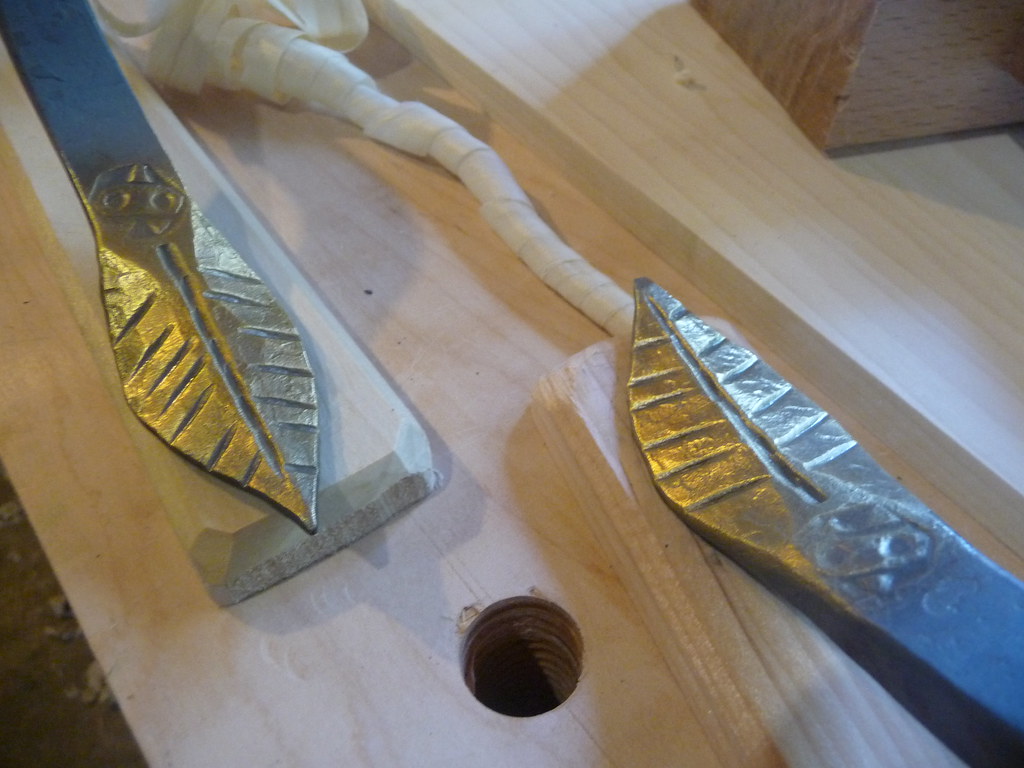
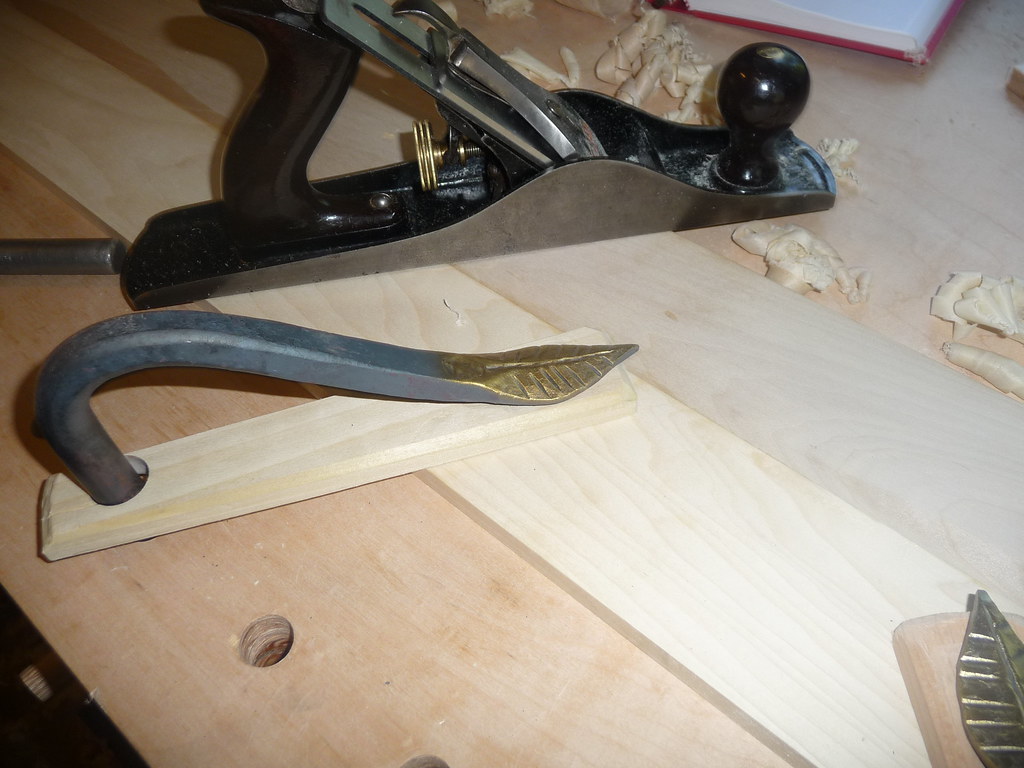
While my holdfasts from Gramercy have worked pretty well (though they needed a lot of sanding to get that way), these from Phil Koontz recently arrived and are amazing.  Not only beautiful, but just the right amount of stickiness.  They visibly leap up out of their holes when tapped, and bite down with plenty of force.  Its so wonderful to meet a perfect tool!


Wednesday, September 21, 2011

The Deal with Deal


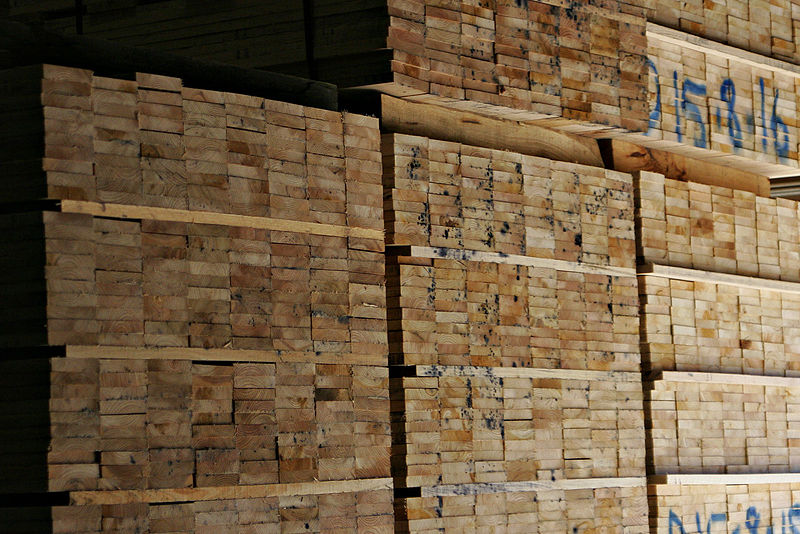
In "The Joiner and Cabinetmaker", the projects are built using a woody substance referred to as "deal".  There is not much agreement on the exact definition, but it is more or less "pine boards".  In the book, Thomas is able to find half-inch deal which is sawn so nicely that it is essentially ready to use as-is.  This might come as a surprise to modern folks who envision such archaic woodworkers going out to select a tree to chop down as the first step in a project.  However, pre-milled wood has long been common.  To saw and mill a log into furniture-grade lumber would take a monumental expenditure of both time and labor.  Specialization is nothing new, so even in Colonial America the sawyers ("saw-ers") and cabinetmakers were not the same people.  While certainly some rustic furnituremakers were growing and cutting their own lumber, in general professional tradespeople were getting their wood from the Home Depot of the day.  Therefore, Thomas had a stash of "nicely sawn" pine boards available to him, already cut to one half-inch thick, and crudely surfaced.

The modern version of obtaining "deal" is to simply go to a lumberyard and buy lumber already milled on 2, if not 4, of its sides.  This is not exactly ready to use as-is, but it is mighty close.  One can save a little bit of money by finding lumber in the rough, which needs to be jointed and planed before use, but Thomas was able to skip this step for the most part.

This gives the modern woodworker aiming to follow in Thomas's footsteps a bit of leeway.  While it would be fun to take rough lumber and completely surface it by hand (and future projects will involve this), the Packing Boxes started with "half inch deal" and so that is what I have been seeking.

The problem, however, is that very few furniture makers are doing this type of thing nowadays.  This is in fact the type of wood using for drawer bottoms, but thin boards have a terrible tendency to cup or warp, and so in general, plywood is the chosen lumber for this application.  The alternating grain directions of the sandwich-like layers (plys) keep the warping at bay.  Indeed, I was at a lumberyard just this week which specializes in cabinetry wood, and the proprietor was utterly amazed that I wanted to buy such thin wood, even after I explained my project.

The end result is that, at least in Coastal Oregon, 9" wide boards of deal at such a small thickness are unavailable.  I've called shops from Washington to California, willing to drive a day to get them.  No luck.  Unless I want to special order wood from New England, or pay to have nice, thick boards wastefully resawn to my narrow requirement (at great expense - and believe me, lumber is already very expensive), I am out of luck.  However, I was able to secure a quantity of 3.5" wide boards at 1/2" thick.  These, I will edge-glue together into larger planks, emulating the wood which Thomas would have found.  This involves a bit of extra work for me, but that is ok.  If I wanted to avoid work, I wouldn't do this project (or I would limply complete it using plywood).

Gluing boards together to make wider ones is nothing new, in fact its very common.  Thomas does it himself, for the schoolbox and chest of drawers.  However, one of the aspects of the packing box which is so interesting is that the top and bottom boards are not glued, they are nailed together using "cross-strengtheners" or battens.  They could easily be glued, but according to the storyline, Thomas has no time to do this.  I take this limitation-- no glue --as one of the main lessons of the project, and so I will still aim to abide by it.  This is where it gets convoluted.

I will be edge-gluing boards to get wider ones, but I will not glue them wide enough to be complete.  I will glue them just shy of where they need to be, so that an extra strip must still be nailed on.  Yes, this is ridiculous by any measure other than that of accuracy by the storyline and harvesting of potential experience, which is what this project is all about.

The gluing operation is not as simple as it sounds.  The boards are machine-milled and, in theory, pretty flat.  However, a quick check with a straightedge shows a fair bit of tell-tale light peeking through.  They are not straight.  So every single adjoining edge is going to have to be checked, planed, and rechecked by hand before gluing. This is just to get to square zero of the project.

Silver lining:  I should be pretty good at truing boards and gluing up small panels by the end of this exercise.  This is a bonus experience not built into the project as designed.  Its like free homework! There are some 30 boards (thats 60 edges) involved, which is a lot of planing.  I have my planes sharpened and honed, oiled and waiting.  There will probably be caffeine involved.

Yes, this is absurd.  Yes, it will be fun.  Yes, I will do it.  
Plain Place for Planes

When oh when will the actual construction of The Joiner and Cabinet Maker's projects begin?  Short answer: tomorrow.  Longer answer: I've been waiting for many tools and materials, as well as finishing the space.  It is still not finished.  It may never be finished.  However, I have the core tools assembled, and as of today, I have lumber and nails enough to build the packing boxes.  I've practiced clinching the nails (more on that soon) and so should be able to take some time to formally start on the boxes tomorrow.

A traditional project can't just use any nails from the hardware store, and so I got ahold of some of these:


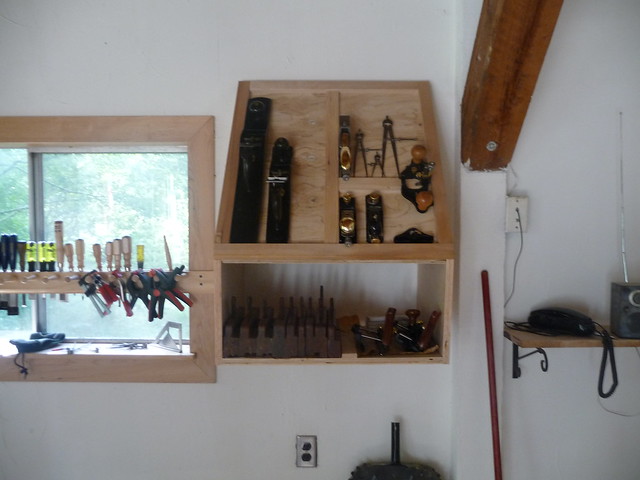
In the meantime, I am chomping at the bit to make a toolchest, but that will not happen until these projects are complete.  It was driving me crazy not to have a place to keep the planes, so I whipped together a till.  Its no work of art, and its a little depressing that it is made of plywood, but it is more important to me to use up shop scraps than it is to maintain some artificial sense of appropriateness for a temporary fixture.  My goal is to have the planes living in a chest within several months, at which point this till will somehow move into the main area of the garage to store something else.  It might look a bit spartan for a typical tool-collector, but I am aiming to abide by keeping only 3 bench planes: a jack, a jointer, and a smoother (not in hand yet).  You can already see here a small and large router plane, a plow, and a skew rabbet, and a shoulder plane along with a handful of wooden rabbet, dado, and moulding planes.  I'm aiming to keep that collection small as well.  No complaints from me, though, if anyone has a half-set of hollows and rounds they no longer need.

Here's the till in its current home, hung on a french cleat:


and a little more detail visible:


Monday, September 19, 2011

Enhancing the sawbenches

Did some quick enhancements to the sawbenches over the weekend.  Namely, added 2 dogholes to each in case I want to use holdfasts to secure work to them.  They are just thick enough (1 3/4") to provide enough friction for great clamping action.  I also used the router plane to etch a shallow mortise for a dowel plate.  This was great fun, its a fantastic tool.  The slightly too-wide edges of the mortise visible in the photo are the result of my sloppy chisel work, no fault of the router plane.  The router plane, while a bit laborious, worked perfectly and left a needlessly ready-for-finish smooth floor on the mortise.  I carefully outlined the plate using a marking knife, but the very wide chisel I was using is also a bit thick, and had a tendency to wedge itself over the knife line when struck.  This is one of those things I knew would happen, and tried to compensate for it, but did not compensate enough.  This is how I learn!  Better on a sawbench than on a piece of fine work...


Wednesday, September 14, 2011

The Joiner's Apprentice's Apprentice

Recently my timeworn cap from Fungi Perfecti  crossed the line into too nasty to consider wearing any longer.  And so, today, a new one from Lost Art Press arrived and I quickly put it on to make sure it fit ok. I forgot I was wearing it, until Kestrel awoke from her nap.  She said "hat!" and snagged it and quickly put it on.  I like her style.

Thursday, September 8, 2011

The Planes of Baltimore

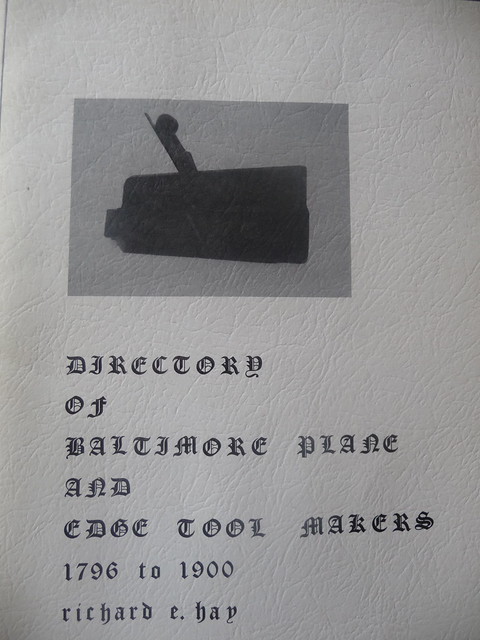
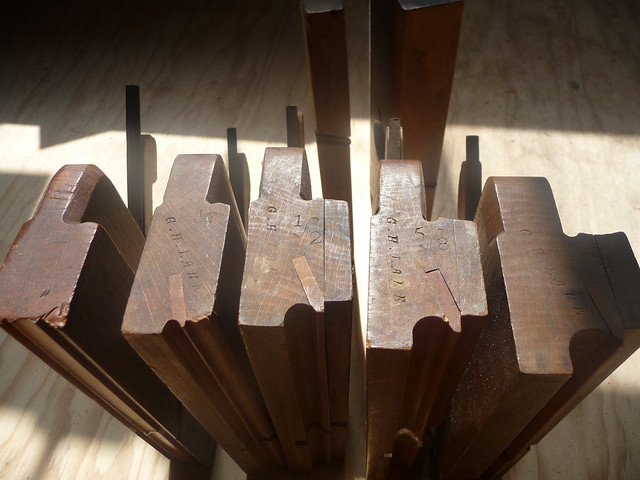
A generous family in Maryland has rescued a long-neglected collection of Baltimore planes and sent them for me to put to use.  Not only did I recieve the planes, but also a booklet full of interesting information about the plane and toolmaking trade in Baltimore.


Here are some of the molding planes in profile:


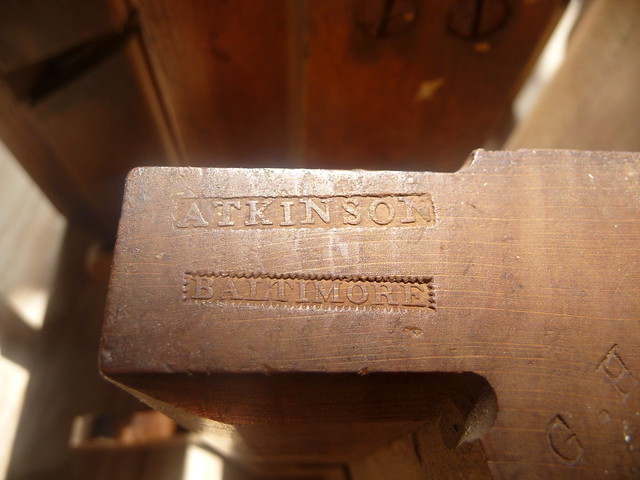
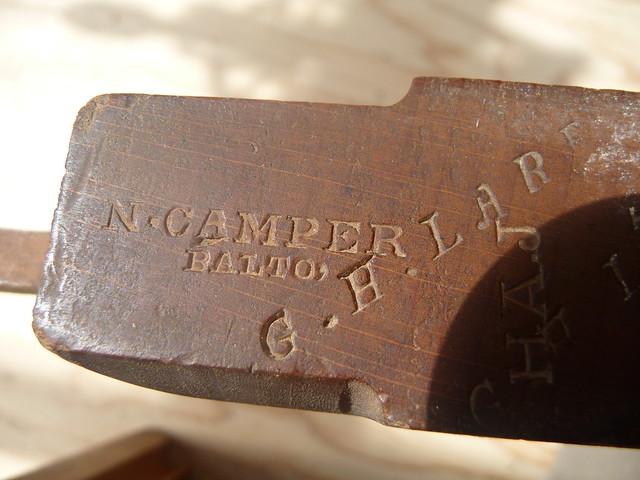
And some of the maker's marks:


From the Directory:

Atkinson was active 1836-1838.  Robert W. Maccubbin sold his planes from 1840-1977.  Napolean Camper was a "plane maker, plane manufacturer, took maker & tool store.  Wife ran a fancy store at same address".  He was on Exeter from 1851 to 1853, then moved to Lexington until 1874, at which point he relocated to Mercer.

The Directory is full of interesting tidbits about what makes Baltimore planes unique, but also information about how the shops all seemed to cooperate with each other.  They shared not only designs for planes (and most likely patterns) but even shared workshop space on occasion.

Huge thanks to my Maryland friends for sharing this haul with me, and I look forward to putting them all to good use.  I still need to clean and sharpen them, but they certainly have lots of usable life left in them.

An Apprentice's First Tool

In the Joiner and Cabinet Maker, our hero Thomas eventually starts earning a little money from his efforts:

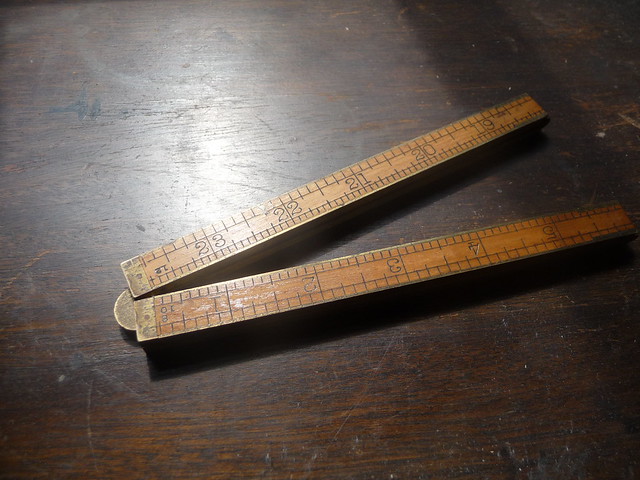
...He feels quite a rich man. "Oh, what a many nice little presents I can make to my brothers and sisters; and then, I can now begin at once to buy tools for myself, and hope to have a pretty good set when I am out of my time."  His first purchase is a two-foot ruler for his pocket, for which he has long been saving up such little money as he could get..."


- The Joiner and Cabinet Maker, p. 104

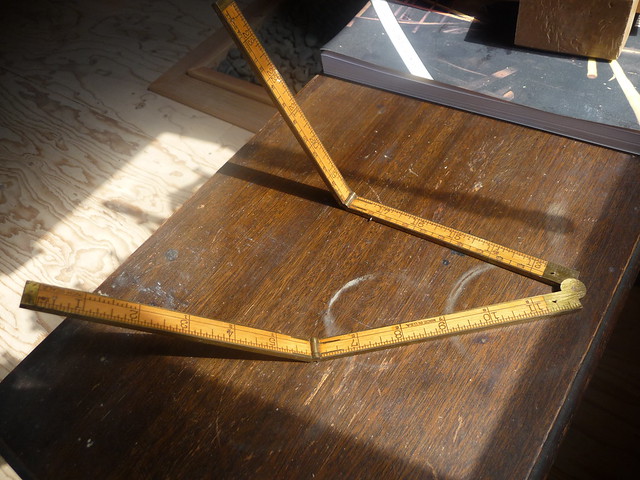
And so I have also set out to secure a two-foot ruler for myself.  With the help of the superbly friendly Joshua Clark, I have found my rule.  The edges are bound in brass to keep it straight, the alignment pins are all present, and the lines are still crisp and clear.  Its an ingenious design, strangely compelling to open and close.  They sure do not make them like they used to.